“APAC and CEE may still win on rent levels, but what we see in the UAE is occupiers choosing reliability and efficiency over just chasing the lowest cost,” says Tilana Kruger, Head of Industrial & Logistics at Cushman & Wakefield Core.
According to Cushman & Wakefield’s Waypoint: Global Industrial Dynamics 2025 report, 76 of the 126 global markets analysed fall within the US$5-10 per square foot (psf) rent band. Dubai and Abu Dhabi sit comfortably within this mid-tier, behind higher-cost markets such as London, Zurich, and Hong Kong. Yet cost is only part of the equation.
"Our clients take a far more holistic view of cost competitiveness," says Mohamed Al Khadar Al Ahmed, CEO of Khalifa Economic Zones Abu Dhabi - KEZAD Group. "Beyond rent, major considerations include energy tariffs, multimodal connectivity, workforce access, and time-to-market."
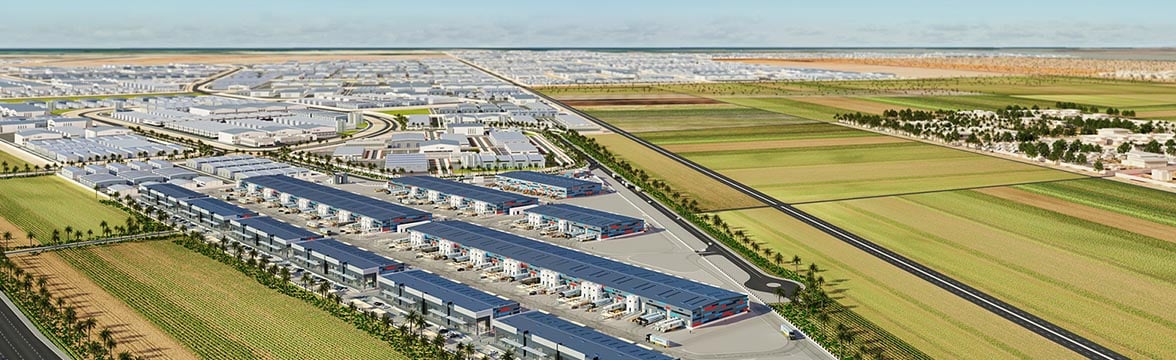
Indeed, this wider view is becoming more prominent as international occupiers face tighter capital constraints and longer decision cycles. KEZAD, one of the largest integrated economic zone operators in the region, has responded by offering built-to-suit options, modular warehouses, and shared office solutions to help companies reduce upfront capex and accelerate revenue generation.
The global Waypoint report also notes that labour and energy costs are now core inputs into location planning. While APAC markets such as India and Vietnam offer lower-cost labour, the UAE is increasingly attractive to companies that require skilled workforces and high service reliability. “What’s really standing out for the UAE is its ability to attract talent. The visa system, stability, and quality of life all feed into that, and for many occupiers it’s as important as the building itself,” Kruger notes.
"We’re seeing growing demand from e-commerce, agtech, aquatech, and data centre operators," Mohamed confirms. "They’re drawn not just by infrastructure, but by the UAE’s proactive push to build innovation ecosystems."
This shift comes as global corporates diversify their supply chains in response to trade tensions and geopolitical fragmentation. The Waypoint analysis highlights that nearshoring and friendshoring strategies are driving more activity into emerging logistics hubs. Abu Dhabi, with its CEPA network (27 agreements and counting), is positioning itself as a springboard for trade across Asia, Africa, and Europe.
KEZAD’s ecosystem model is designed to support this diversification. By clustering suppliers, manufacturers, and specialised logistics providers within the same zone, tenants can reduce transport costs, shorten production cycles, and de-risk supply chain disruption. "Through our value chain strategy, we capture everything from raw materials to processing, packaging, and logistics in one integrated platform," Mohamed notes.
“KEZAD is a good example of how clustering works in practice - bringing suppliers, manufacturers and logistics into one place cuts costs, shortens production cycles, and helps companies build more resilient supply chains,” says Kruger.
Energy also plays a critical role in cost and carbon performance. In addition to encouraging rooftop solar, KEZAD Utilities & Facilities Management operates a 100km gas network to provide reliable, lower-emission energy access. This utility infrastructure supports both cost competitiveness and decarbonisation goals for industrial occupiers.
The wider UAE market is also mobilising. Free zone operators in Dubai and Abu Dhabi are now exploring tools like carbon management systems and AI-based energy monitoring, while experimenting with carbon credit frameworks to offset green construction costs. For example, tenants installing rooftop solar can benefit from reduced utility rates, while pilot programs offer carbon offsets for LEED-certified buildings. These strategies are still maturing, but they underscore a shift: industrial sustainability is increasingly being monetised. “We’re seeing an increasing number of institutional investors entering the thriving logistics and industrial market with plans to develop sustainably. Advanced lighting, climate control, Al Sa’fat certifications and smart building systems are now standard for new-builds. Developer groups looking to deliver sustainable Grade A product are rapidly enabling market evolution.” says Ben Rose, Director of Capital Markets at Cushman & Wakefield Core.
"Companies want long-term efficiency, not just low rent," Mohamed adds. "They’re looking for energy stability, digital readiness, and speed to market. That’s where the UAE excels."
“As well as key investment metrics such as sufficient yield, capital value per sq ft etc, new high quality entrants to the market such as Prologis and Blackstone will drive standards forward for built stock. We are expecting to see significant investment and development going forwards.” Rose states.
While the Gulf may not compete on headline cost with emerging Asian markets, its differentiated offer - anchored in connectivity, stability, and ecosystem value - continues to appeal to future-focused occupiers. As global companies increasingly look for certainty in uncertain times, platforms like KEZAD are showing how the region can deliver both resilience and return.