
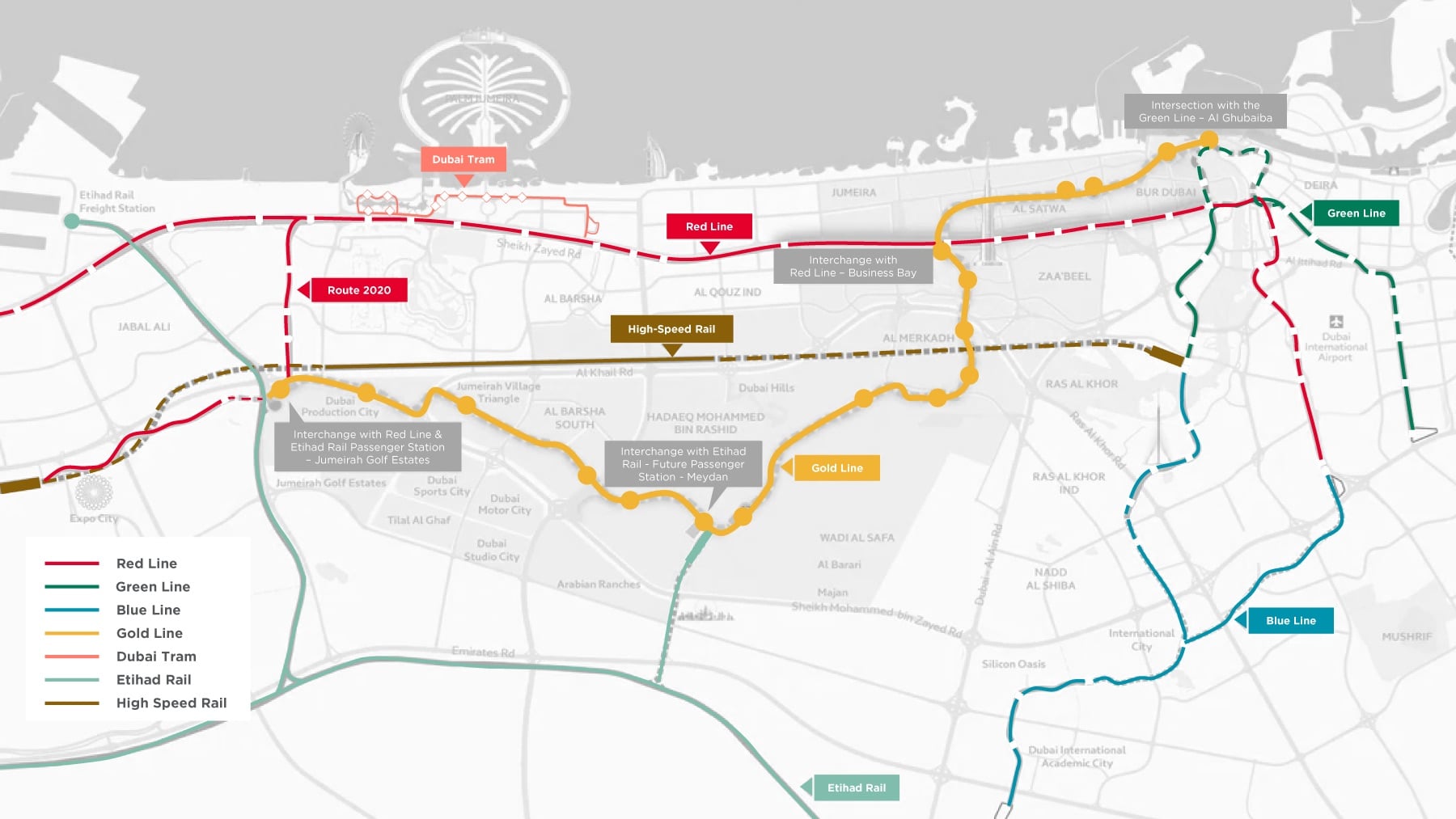
Dubai's AED 34 billion metro expansion will alter the city's accessibility map and, with it, the price of land in places that have never had a station.
Dubai is, at its core, a road city. Its commercial corridors, residential communities, and industrial zones were predominantly planned around the car. The metro lines that exist have shaped pricing within their immediate catchment, but they have never been the primary logic of the city's real estate map. The new Metro Gold Line - 42 kilometres of fully underground track, 18 stations and AED 34 billion in public investment, due for completion in September 2032 - is unlikely to change that overnight, but markets that have seen comparable expansions, Singapore's Circle Line and London's Elizabeth Line among them, have established a consistent pattern: land within walkable distance of new stations reprices ahead of completion, with the most pronounced effect in areas where transit was previously absent rather than those where an existing service is merely extended. Several of the markets the Gold Line will connect fall squarely into that category.
Below we look at the main areas expected to benefit from the new line.
Meydan and MBR City
The Nad Al Sheba, District One, Majan, and Dubai Hills corridor has accumulated significant residential density over the past decade without the public transit support to match. Combined with the planned Etihad Rail interchange, the Gold Line transforms this from a decentralised node into a mid-ring corridor with multimodal connectivity to Abu Dhabi, the northern emirates, and central Dubai. The office implication is longer in the making, but demand for decentralised Grade A product is already building as the city's core CBDs approach full occupancy. Meydan's scale and masterplan flexibility make it the most credible candidate for the next wave of mixed-use office development outside the established clusters, and the Gold Line reinforces that.
JVC and JVT
Jumeirah Village Circle has built a substantial residential base over the years, but it has never had a metro station. A new Gold Line station should lift the ceiling on residential pricing while, commercially, demand will likely come from SME, flex, and community office space rather than large corporate occupiers; JVC's floorplate supply and developer profile are not configured for the latter. That transition from predominantly residential to mixed-use commercial is a pattern well-documented in comparable mid-ring markets globally once transit arrives, and there is no obvious reason Dubai would diverge from it.
Jumeirah Golf Estates
The commercial opportunity at JGE is narrower but more defined. Its planned interchange - connecting Red Line, Gold Line, and Etihad Rail – will transforms the luxury residential enclave that has always sat out on its own into an accessibility node. The likely office demand here follows directly from the residential profile: family offices, wealth management firms, and professional services operators who currently anchor in DIFC or Downtown but may find a lower-density, well-connected environment commercially preferable. A dual rail interchange makes this a much more viable option for this occupier profile.
Mina Rashid and Al Ghubaiba
Al Ghubaiba is the designated transit origin point of the Gold Line and will be affected differently from the stations further along the line. Origin points are where journeys begin, and for this area that framing is apt: the more immediate impact is likely to be felt as a workforce source market, with junior and mid-level staff gaining access to a much larger network of office and residential districts than they currently have. Inward office demand of any quality will require regeneration first; the heritage character, waterfront access, and relative affordability that have drawn creative and tourism-linked interest to the area are still there, but they need investment behind them before they translate into sustained commercial occupancy. This new station will create the conditions for that investment.
Business Bay
The impact for Business is more around deepening demand rather than transformation. A double interchange connecting Red and Gold lines expands the catchment of workers who can reach the area without a car, raising the ceiling on rents in buildings close to the station and adding liquidity to a market already sitting at near-capacity. For an established secondary CBD performing at this level, incremental accessibility improvement converts fairly directly into marginal rental support; leases signed today with 2032 break options should factor that in.
The bottom line
Markets that have seen comparable metro expansions - Singapore's Circle Line, London's Elizabeth Line – have shown us that land within walkable distance of new stations will reprice ahead of completion, with the most pronounced effect in areas where transit was previously absent rather than those where an existing service is merely extended.